
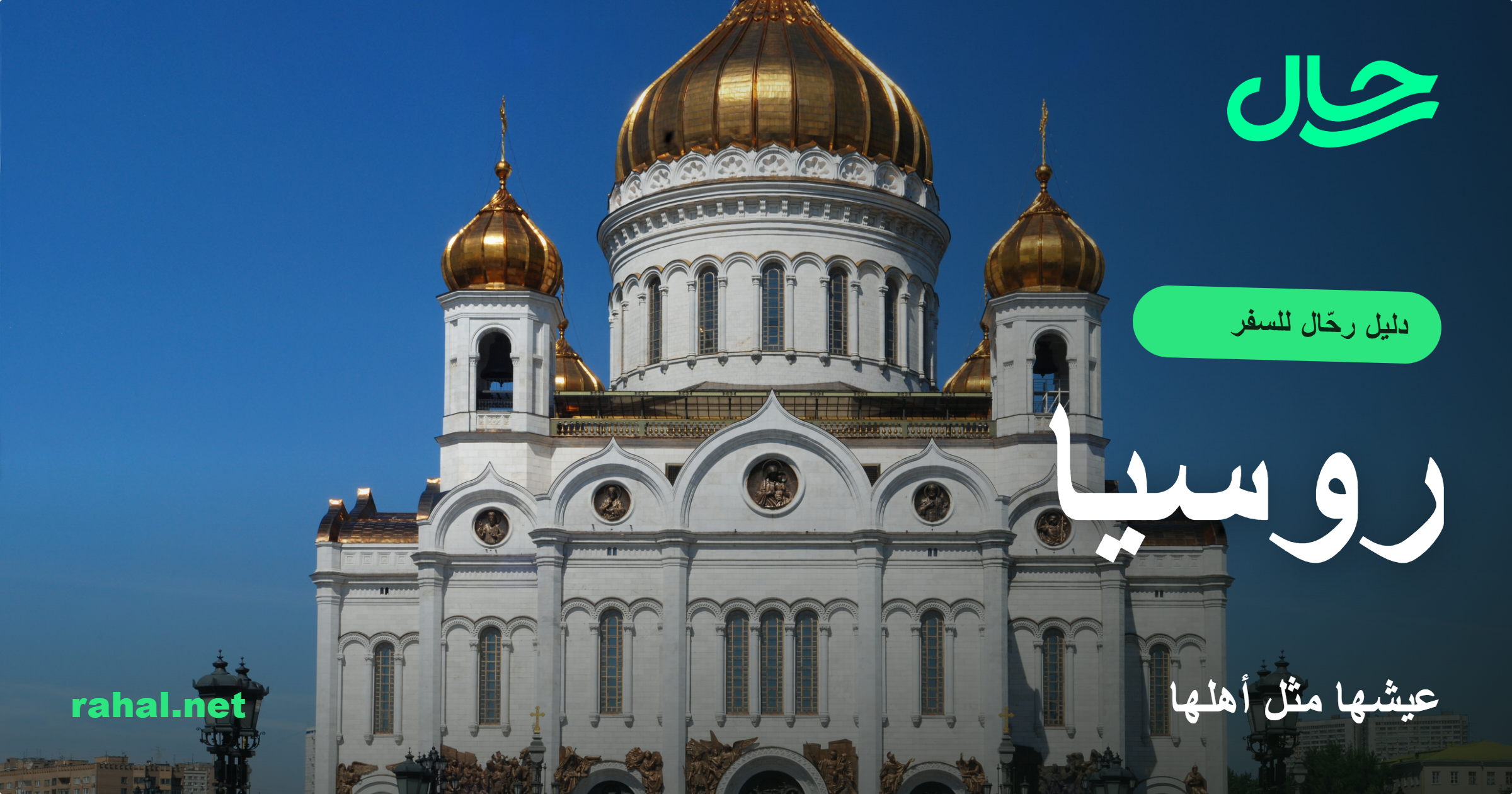
Russia Like a Local: The Real Travel Guide for Iraqis
The mistake every tourist visiting Russia makes is arriving either scared or biased. The image of Russia in Western media and its real image on the ground are worlds apart. Its people live with immense cultural depth, literature and classical music and art that have shaped human civilization, and a hospitality that surprises anyone expecting coldness. Russia isn't a country — it's a continent stretching from the Baltic Sea to the Bering Strait. This article isn't a list of landmarks. It's a guide to living.
Who lives there?
Russia has around 144 million people, with a median age of 40, and it's the largest country in the world by area. Over 74% of the population lives in cities. The official language is Russian, and the Cyrillic alphabet looks complex at first, but you can learn to read the letters within two days, and that opens many doors.
Religion: Orthodox Christianity is the dominant cultural identity (70% identify as Orthodox), but Russia has the second-largest Muslim population in Europe: around 20 million Muslims, concentrated mainly in Chechnya, Dagestan, Tatarstan, and Bashkortostan, and notably present in major cities.
Ethnic diversity is immense: 190 officially recognized ethnic groups. Ethnic Russians make up 80%, with the rest Tatars, Chechens, Bashkirs, and dozens of other peoples — all within a single country.
The daily rhythm: Moscow and St. Petersburg are cities that sleep late and wake late. Restaurants and cafés operate until 2 or 3 am. The metro runs from 5:30 am until 1 am. Social life starts after 8 pm.
How much does daily life cost?
Moscow is a city of two levels: very expensive if you live like a tourist or foreigner, and surprisingly cheap if you live like a local. A Russian citizen earns an average of 70,000–90,000 rubles/month (roughly $750–1,000) in Moscow, reflecting the local cost level.
A meal at a budget restaurant costs about 400–700 rubles ($4–8). An office worker's cafeteria lunch (стоoловая, stolovaya) costs 200–350 rubles, and these popular cafeterias are among the best places for cheap, genuine food.
Rent: a one-bedroom apartment in central Moscow ranges from 60,000–90,000 rubles/month ($650–1,000), dropping to 35,000–50,000 rubles outside the center. A monthly metro pass in Moscow costs about 3,000 rubles ($33) and covers all transport.
Surprisingly cheap: public transport, popular food, theater and opera (Bolshoi opera tickets start from 500 rubles for back seats), and vegetables and basic groceries. Expensive: Western restaurants, international hotels, and any imported product.
(Numbeo Moscow 2026 figures: numbeo.com/cost-of-living/in/Moscow)
How do locals get around?
The Moscow metro is one of the greatest metro systems in the world, not just for efficiency but for its architecture. Stations like Komsomolskaya and Novoslobodskaya are genuine underground art museums, with mosaic ceilings, chandeliers, and carvings from the 1930s and 1940s. Trains arrive every 90 seconds at peak hours.
Within cities: a mix of metro, tram, buses, and mini-buses (marshrutka). The Yandex Go app (the Russian version of Uber) is used for taxis, much cheaper than traditional taxis and reliable.
Between cities: RZhD trains connect all of European Russia. Moscow to St. Petersburg takes 4 hours on the Sapsan train, which beats flying once you factor in airport time. Book through the official website rzd.ru or the Tutu.ru app.
What confuses outsiders: unofficial taxis ("bombila") are common — people flag down regular cars on the street and negotiate a fare. Don't do this as a foreigner who doesn't speak the language.
What do they eat, and when?
Russian cuisine is tied to the climate: warm, hearty, and filling. Breakfast at home is simple: porridge (каша, kasha), eggs, or cottage cheese (творог, tvorog) with tea. Café breakfast runs from 8 to 11 am.
Lunch is the main meal, from 1–3 pm. Dinner is late, from 8–11 pm, and sometimes stretches past midnight during social gatherings.
Dishes you must try: borscht, red beetroot soup, different in every home and region. Pelmeni, similar to dumplings but with beef — ask about meat ingredients if halal matters to you. Blini, thin pancakes with sour cream or caviar. Russian-style shawarma in long flatbread, developed by workers from Central Asia and now a nightlife icon in every city.
A myth worth busting: that Russians drink vodka constantly. Many in the younger generation (under 35) don't drink alcohol or drink rarely. Tea culture is far stronger than outsiders expect, and the traditional samovar is still present in homes.
Worth remembering: "Stolovaya" restaurants are the hidden treasure. Popular cafeteria-style restaurants found in every neighborhood — take a tray, choose what you want from what's in front of you, and pay by weight or by dish. The food is genuine and cheap, and real locals eat there. Search "Столовая" on Google Maps in any city.
The unwritten rules
The default Russian public expression is serious and stern, especially with strangers and in public places. Smiling at a stranger for no reason seems odd or naive to them. But once you're inside their home or become an acquaintance, warmth and hospitality know no limits.
Hospitality is a genuine Russian spirit: if invited to a Russian home, never arrive empty-handed — sweets, a cake, or flowers (always an odd number for happy occasions; even numbers are reserved for funerals). Expect them to pile the table with food.
Religious sites: Orthodox churches require modest dress, and women cover their heads when entering (a simple scarf is enough). Mosques have their own usual customs too.
Sensitive topics: foreign policy and any talk of the war or Ukraine with strangers carries social risk — avoid it with people you don't know. Soviet history is an emotional topic; some take pride in it and others reject it, so don't assume a position.
What shows poor manners: entering the metro or a bus before people exit, not giving up your seat for the elderly (a serious social penalty), and photographing inside certain metro stations, airports, and government buildings, which is explicitly forbidden.
Where do locals live?
Moscow is a city of ring roads: neighborhoods close to the center are expensive and touristy, and the farther you go from the ring road, the quieter, cheaper, and more "Russian" the neighborhood becomes. Real Muscovites live in neighborhoods like Maryino, Vykhino, and Medvedkovo, east and south of the city.
Massive Soviet-era buildings (хрущёвка, khrushchyovka) are everywhere — small but practical apartments. The new generation increasingly moves to modern residential complexes outside the third ring road.
As a visitor: Booking.com and Ostrovok.ru (the local Russian site) for hotels. Airbnb-style apartments are still available through alternative local services. Hostels in Moscow and St. Petersburg are high quality and among the cheapest options in Europe.
🎵 Hear Russia before you arrive
Russian classical music — Tchaikovsky, Rachmaninoff, and Shostakovich — is among the deepest human artistic achievement. But Russia today has a vibrant music scene: Russian rock from the '80s (Viktor Tsoi and Kino), electronic music from Moscow, and Russian hip-hop, hugely popular among youth. Songs by Kino are a symbol of an entire generation, much like the Beatles were for another.
For the Iraqi traveler 🇮🇶
Visa: Iraqi passport holders need a Russian visa to enter. Apply at the Russian Embassy in Baghdad or the consulate in Erbil. Standard requirements: a valid passport, an official invitation from a registered hotel or Russian travel company (this is mandatory, not optional), an application form, and photos. Application fees range from $50–80. Processing takes one to three weeks. Check the official Russian Embassy in Baghdad website, as procedures change. (Verified: June 2026)
Flights: FlyDubai via Dubai to Moscow. Turkish Airlines via Istanbul. Iraqi Airways connects Baghdad to Moscow intermittently — check its current schedule. Sheremetyevo Airport (SVO) is the largest in Moscow and most used for international flights.
Cash and cards: The situation changed after 2022. International Visa and Mastercard cards don't currently work in Russia. The practical solution: carry cash in dollars or euros and exchange it for rubles upon arrival at currency exchange offices (обмен валюты). The Chinese UnionPay card works at some Russian banks. Plan to rely entirely on cash throughout your trip.
Halal food: Moscow has a large Muslim community and available halal options, especially in neighborhoods like Maryino and near the Moscow Cathedral Mosque. The Tatar and Bashkir region (Kazan, the capital of Tatarstan) is a distinctly Muslim city where nearly all the food is halal. The Zabihah app and Google Maps searches for "halal" can help you in Moscow.
Community: The Iraqi community in Russia is relatively small, mostly in Moscow among students and residents dating back to the Soviet era. The broader Arab community is larger. "Arabs in Russia" groups on Telegram (the most used platform in Russia) have useful, up-to-date practical information.
The honest take
Russia is an exceptional destination for anyone wanting something completely different from typical European tourism. The civilization runs deep, the art is authentic, and prices are unbelievably cheap compared to Western Europe. The challenges are real: the language barrier is stronger here than in any European country (the Cyrillic alphabet and limited English on the street), and the bank card issue requires advance planning.
What gets overlooked: Kazan, the capital of Tatarstan, about an hour's flight from Moscow. A Muslim city with a massive mosque, a Tatar kremlin, halal food, and human warmth that surprises visitors. It brings together two civilizations in one place without friction. Also St. Petersburg, underappreciated compared to Moscow despite arguably being more architecturally beautiful — the "Venice of the North" with its 18th-century canals and palaces.
Who it suits: the curious Iraqi traveler who wants to see a civilization that's neither European nor Asian, who loves literature, art, and music, and who's ready to handle practical challenges (language and cards) in exchange for an experience unlike anything else.
Bottom line: Russia teaches you that beauty and complexity can coexist, and that the image you see from a distance rarely resembles the person you actually meet on the ground.
FAQ
Does an Iraqi passport need a visa for Russia?Yes, Iraqi passport holders need a Russian visa. An official invitation from a registered hotel or Russian travel agency is required as part of the application. Apply at the Russian Embassy in Baghdad or the consulate in Erbil, and allow enough time since processing takes one to three weeks.
How much does a trip to Russia cost for an Iraqi traveler?Russia is currently one of the cheapest destinations on the European continent. A budget traveler needs $35–55 daily (hostel, local food, public transport). A traveler at a mid-range hotel with good restaurants needs $80–130 daily. A round-trip flight ranges from $450–750.
Is halal food available in Russia?In Moscow, available and expanding. The large Muslim population (20 million) has made halal restaurants available, especially in Muslim-dense neighborhoods. Kazan (Tatarstan) is nearly entirely halal. Outside major cities, options are more limited and require searching.
Is English enough to get by in Russia?Noticeably less than Western Europe. The younger generation in Moscow and St. Petersburg speaks reasonable English. On the street, in small shops, and on transport, you'll need a translation app (Google Translate's camera mode is very useful for reading Cyrillic). Learning 10 Russian words opens many doors.
What's the best time to visit Russia from Iraq?Two ideal windows: May and June (wonderful Russian spring, and St. Petersburg in June has the "White Nights" when the sun barely sets) and September and October (beautiful golden autumn, lower prices, fewer crowds). Winter (December–February) is a completely different experience — visually beautiful but the cold reaches -20°C in Moscow.
What do I do without an international bank card in Russia?Bring cash (dollars or euros) and exchange it for rubles upon arrival at currency exchange offices found at airports and shopping centers. The Russian ruble is the only currency accepted everywhere. Plan your entire budget in cash and bring extra reserve.
Sources: Wikivoyage (CC BY-SA), CIA World Factbook (public domain), cost figures from Numbeo Moscow, the Russian Embassy in Baghdad for visa information. Last updated: June 2026