
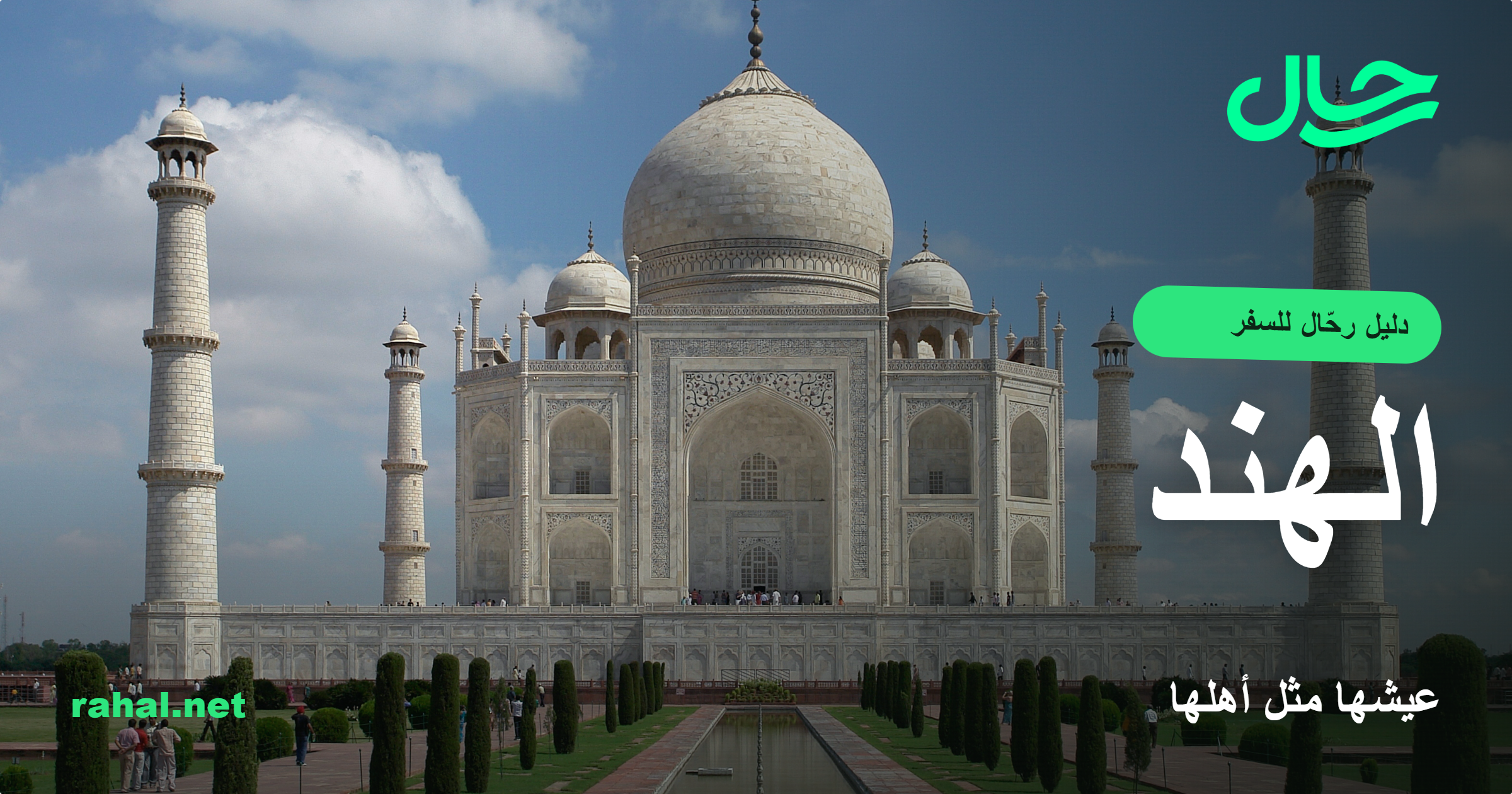
India Like a Local: The Real Travel Guide for Iraqis
The mistake every tourist visiting India makes is coming looking for a Bollywood-movie image: vivid colors, spices, incense in the air, and people dancing. India is deeper, louder, and more complex than any single image. Its people live a life where 1.4 billion humans move at the same time, and the chaos you see from the outside has an internal logic you only understand once you actually live it. This article isn't a list of landmarks. It's a guide to living.
Who lives there?
India is the second most populous country in the world at 1.4 billion people, with a median age of just 28 — meaning it's an extremely young society with enormous energy. Over 35% of the population lives in cities, and the rest across a vast countryside.
Languages: Hindi and English are official, but in reality there are 22 officially recognized languages and more than 1,600 local dialects and languages. English is the language of work and higher education across India, and the language of communication between different states — since someone from Tamil Nadu and someone from Punjab often only understand each other in English.
Religion is incredibly diverse: 80% Hindu, 14% Muslim (over 200 million Muslims, the second-largest Muslim population in the world after Indonesia), plus Sikhs, Christians, Buddhists, and Jains. This diversity isn't just talk — it's daily life you encounter in restaurants, festivals, and neighborhoods.
The daily rhythm: life starts very early, markets open from 6 am. India isn't a single country — it's a small continent, with every state having its own character, food, music, and way of life.
How much does daily life cost?
India is one of the cheapest tourist destinations in the world for foreign visitors. Delhi residents earn an average of ₹35,000–45,000 rupees/month (≈$420–540) for a private-sector employee, reflecting the local price level. A meal at a budget restaurant costs about ₹150–300 rupees (under $4), and a popular street food dish costs ₹50–100 rupees (under $1.50).
Rent: a one-bedroom apartment in central Delhi or Mumbai ranges from ₹15,000–25,000 rupees/month ($180–300), dropping to ₹8,000–12,000 rupees outside the center. Local transport is very cheap: an auto-rickshaw for 3 km costs about ₹50 rupees, and Uber and Ola (the Indian version) are cheaper than in most of the world.
Surprisingly cheap: street food, spice markets, train transport, and local tailoring and clothing. Relatively expensive: international hotels, tourist restaurants, and chauffeured rental cars.
(Numbeo Delhi 2026 figures: numbeo.com/cost-of-living/in/New-Delhi)
How do locals get around?
Indian Railways is the lifeblood of the country: it carries 23 million passengers daily and is one of the largest rail networks in the world. The train isn't just transport — it's a complete social experience. Book in advance through the IRCTC app (the official site), and take 3AC class (three-tier air-conditioned) for comfort at a reasonable price.
Within big cities: the Delhi and Mumbai metros are excellent, clean, air-conditioned, and symbolically priced. Ola and Uber operate across India and are much cheaper than regular taxis. The tuk-tuk rickshaw is an authentic experience, but agree on the price before getting in.
Domestic flights: IndiGo and Air India Express connect every major city at very cheap prices if booked in advance (sometimes $20–30 between two cities).
What confuses outsiders: traffic congestion in Delhi and Mumbai is real and exhausting. From 8–10 am and 6–9 pm, plan your trips assuming every distance will take double the expected time.
What do they eat, and when?
Indian food isn't just "curry" — that's a reductive oversimplification. Every state has its own distinct cuisine: dosa (a thin crispy pancake) in South India, Hyderabadi biryani which many Iraqis say resembles Baghdad's quzi, dal makhani in the north, and fish curry on Kerala's coast.
Breakfast in most Indian homes: milk tea (chai) with flatbread (roti) or rice. Southern breakfast is different: dosa and idli with coconut chutney. Street food starts from early morning.
Lunch is the main meal, from 1–3 pm. Dinner is from 8–10 pm (Indians eat relatively late). Local eateries are called dhabas — similar to Iraqi roadside restaurants but with a completely different character.
Dishes you must try: halal Hyderabadi biryani from Paradise or Shadab restaurant, street-style Indian chowmein (a Chinese dish that became Indian), lassi (a yogurt drink), and authentic Indian samosas, wrapped in a distinct pastry unlike what we're used to.
A myth worth busting: that all Indian food is unbearably spicy. Reality: many dishes are mild, and you can always ask for "less spicy" and they genuinely comply.
Worth remembering: Chandni Chowk market in Old Delhi, on Friday after Friday prayers, is one of the liveliest food scenes in the world. Every alley has specialized in one dish for 400 years. Walk in without a plan and walk out full.
The unwritten rules
Greeting: Namaste (palms pressed together with a head nod) is the official, universally accepted greeting. Handshakes are common in work settings. A woman may not extend her hand to shake with a foreigner — don't take it as an insult.
The head wobble: Indians shake their head side to side in a way that looks like "no" but actually means "yes, understood, okay." This head wobble is one of the things that confuses visitors most.
Dress and behavior at temples and mosques: removing shoes is mandatory when entering any sacred place regardless of religion. Covering shoulders and knees is necessary for both women and men in most religious and rural settings.
Bargaining at local markets (bazaars) is normal and expected — start at half the asking price. In official shops and large stores, prices are fixed.
What shows poor manners: eating street food with your left hand (the left hand is associated with personal hygiene in Indian culture), photographing people without permission, especially women, and rushing interactions (India moves at its own pace and doesn't rush).
Where do locals live?
Greater Delhi alone has 32 million people, and locals live in neighborhoods far from tourist areas. Karol Bagh, Lajpat Nagar, and Saket are real-life neighborhoods. Tourist areas like Connaught Place and India Gate are daytime-only zones.
For apartment sharing: NoBroker and Housing.com are the most used. OYO is a budget Indian hotel chain found in every city, priced $15–40/night with variable quality — check reviews before booking.
Housing customs: many Indian homes will also ask you to remove your shoes at the door. If invited to an Indian home, don't come empty-handed: sweets or fruit are always well received. Indian hospitality is very generous and may even embarrass you with the amount of food served.
🎵 Hear India before you arrive
Indian music isn't just Bollywood. There's Hindustani classical music with roots going back 2,000 years, Sufi qawwali music (Nusrat Fateh Ali Khan is one of the world's most famous singers), Carnatic music from South India, and a modern Indian rap wave. Songs by A.R. Rahman (the Slumdog Millionaire soundtrack) are a good entry point for a first-time traveler.
For the Iraqi traveler 🇮🇶
Visa: Iraqi passport holders need an Indian visa to enter. Good news: India offers an e-Visa you can apply for online through the official website indianvisaonline.gov.in without visiting an embassy. The tourist visa fee is around $25, and processing takes 3–5 business days. Confirm on the official website before applying, as conditions change. (Verified: June 2026)
Flights: There are currently no direct flights from Iraq to India. FlyDubai and Emirates connect Baghdad and Erbil to Delhi and Mumbai via Dubai. Gulf Air via Bahrain. Qatar Airways via Doha. Turkish Airlines is another option via Istanbul, though with longer travel time.
Cash and cards: India is moving toward digital payments at an astonishing pace. The UPI app (India's payment system) is extremely widespread but requires an Indian bank account. As a visitor, a Visa or Mastercard works at hotels and shopping malls. Carry cash (rupees) for local markets and daily transport. A Wise card is best for exchanging at the real exchange rate.
Halal food: India is one of the richest countries for halal options outside the Arab world, given its 200 million Muslims. The city of Hyderabad is almost entirely halal, and its famous biryani is legendary. Old Delhi (Purani Dilli) has halal food on every corner. Kerala's coast is entirely halal with a historic Arab community. Use the Zabihah or HalalTrip app to find the nearest halal restaurant.
Community: The Iraqi community in India is small but present, mostly students in Delhi and Bangalore. The broader Arab community is larger. Facebook groups like "Arabs in India" have useful practical information.
The honest take
India isn't a comfortable destination in the European sense: the chaos is real, pollution in big cities is noticeable, and bureaucracy can wear down your patience. But those who stay patient and keep their eyes open find a living civilization continuous for 5,000 years, unmatched food, and human generosity that leaves a mark.
What gets overlooked: Kerala in South India. Green nature, clean beaches, wonderful seafood, a large Muslim community, and a 97% literacy rate (the highest in India). Far calmer and cleaner than Delhi and Mumbai. Also Jaipur (the Pink City) in the northwest, one of the most beautiful cities in the world, underappreciated by tourists compared to its neighbor Agra.
Who it suits: the curious Iraqi traveler who wants to see a completely different civilization, eat food that reminds them of home spices in unexpected ways, and see how 200 million Muslims live peacefully alongside neighbors of different faiths. Not for someone wanting European-style comfort.
Bottom line: India surprises you with how much beauty and chaos can coexist in the same place, and teaches you that patience isn't weakness — it's the only path to understanding one of the deepest places on Earth.
FAQ
Does an Iraqi passport need a visa for India?Yes, but the good news is India offers an e-Visa you apply for online through the official website indianvisaonline.gov.in without visiting an embassy. The tourist visa fee is around $25, and processing takes 3–5 business days. Confirm on the official website before applying.
How much does a trip to India cost for an Iraqi traveler?A budget traveler needs roughly $40–60 daily (hostel or OYO, local food, public transport). A traveler at a mid-range hotel with restaurants needs $90–140 daily. A round-trip flight ranges from $400–700 depending on season and transit.
Is halal food available in India?Abundantly. India has over 200 million Muslims, and every major city has halal neighborhoods and restaurants. Hyderabad is almost entirely halal, and Kerala, Old Delhi, and Kolkata offer extensive options. The HalalTrip and Zabihah apps can help.
Is English enough to get by in India?Yes, excellently so in big cities, hotels, and tourism. India is an English-medium country for writing and higher education, and the younger generation sometimes speaks better English than in some Western countries. In villages and rural areas, you'll need a translation app.
What's the best time to visit India from Iraq?Two ideal windows: October and November (after the rainy season, pleasant weather, green landscapes) and February and March (spring, before the intense heat). Avoid May and June in North India — temperatures reach 48°C in Delhi. Monsoon season (July–September) is beautiful in the south but tough in the north.
What's the most important thing to prepare for a trip to India?Three practical things: bring stomach medicine, since the change in food and water sometimes affects new visitors. Download Google Maps offline for your cities before arrival. And get an Indian SIM card from the airport (Airtel or Jio) at very symbolic prices compared to international roaming.
Sources: Wikivoyage (CC BY-SA), CIA World Factbook (public domain), cost figures from Numbeo Delhi, the official Indian e-Visa website for visa information. Last updated: June 2026.